
SAP Cloud vs On Premise: A Practical Decision Guide for 2026

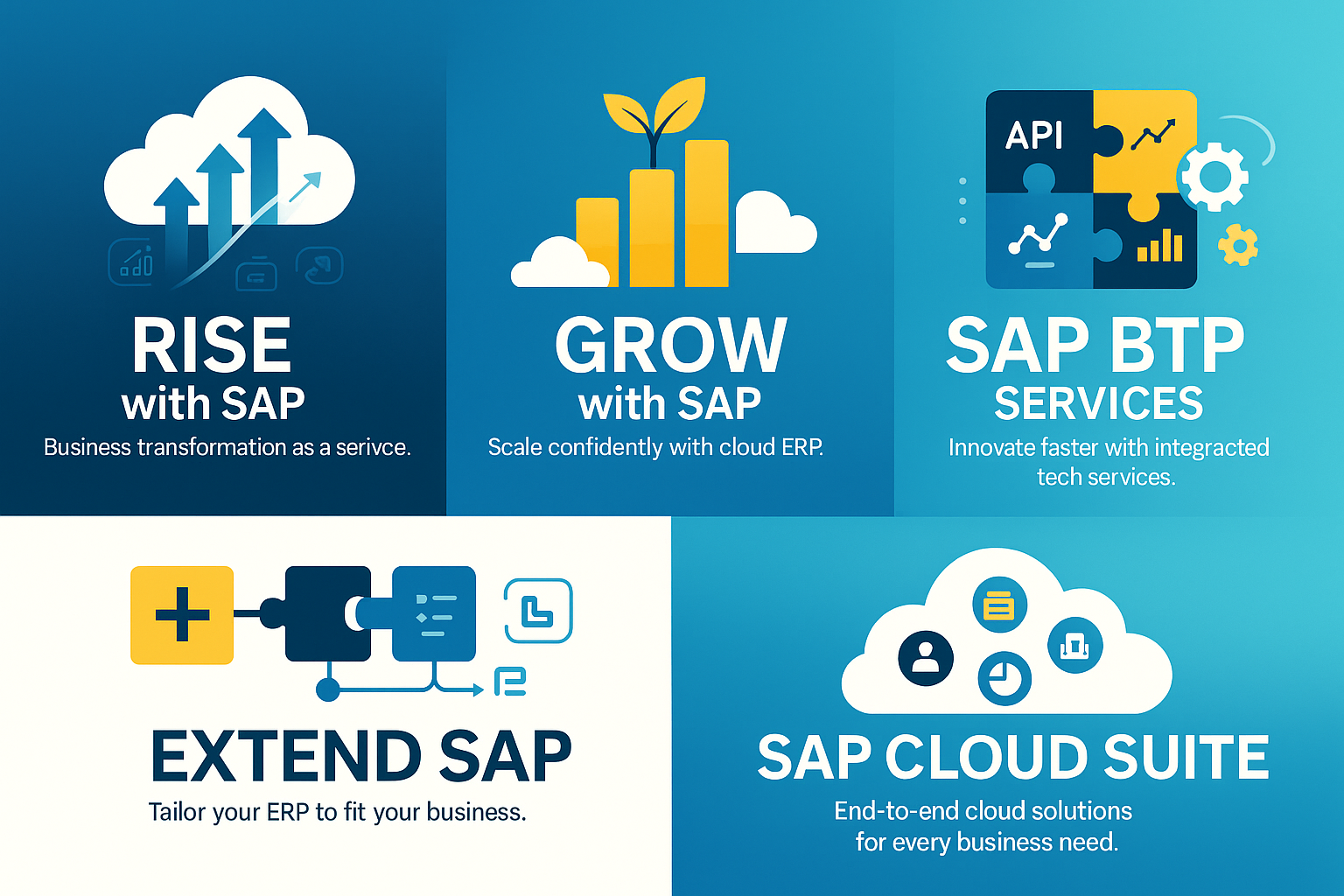
For SAP leaders, the cloud versus on premise decision is no longer a simple infrastructure comparison. It is an operating model decision that affects transformation speed, resilience, security responsibilities, cost visibility and access to innovation.
The right answer depends on your business priorities and the realities of your SAP landscape. A highly customised SAP ECC environment with strict latency or sovereignty constraints may need a different path from a business that wants rapid standardisation on SAP Cloud ERP. Many enterprises will use a hybrid model during the transition.
This guide provides a practical framework for evaluating SAP cloud and on premise options, including SAP Cloud ERP Private through RISE with SAP and SAP workloads operated on hyperscalers such as AWS, Microsoft Azure and Google Cloud.
What is the difference between SAP cloud and on premise?
With an on premise model, the organisation owns or controls the infrastructure and carries primary responsibility for capacity, lifecycle management, availability, security operations and disaster recovery. The environment may run in a company data centre or in a dedicated colocation facility.
With a cloud model, infrastructure capacity is consumed as a service. Responsibility is shared across the cloud provider, SAP, the implementation partner and the customer. The exact boundary depends on whether the landscape uses infrastructure as a service, SAP Cloud ERP Private, SAP Cloud ERP or another managed model.
The central question is not simply where SAP runs. It is which operating model gives the business the right balance of control, resilience, agility and accountability.
SAP cloud vs on premise comparison
| Decision area | SAP in the cloud | SAP on premise |
|---|---|---|
| Investment model | Consumption or subscription based operating expenditure with flexible capacity | Capital investment in infrastructure, licences and data centre capacity |
| Provisioning | Infrastructure can be provisioned and automated quickly within approved guardrails | Capacity changes depend on procurement, installation and data centre processes |
| Control | Control is governed through service choices, architecture, policy and shared responsibility | Direct control over infrastructure, maintenance windows and physical environment |
| Resilience | Access to zones, regions and native recovery services, subject to correct architecture | Resilience depends on the organisation’s secondary sites, hardware and operating discipline |
| Security | Provider secures the underlying platform while the customer retains defined responsibilities | The organisation is responsible for the full technology stack and operating controls |
| Scaling | Capacity can expand or contract without a new hardware procurement cycle | Scaling is bounded by installed capacity and available data centre resources |
| Innovation | Easier access to cloud data, integration, automation and AI services | Innovation can be slower when it requires new infrastructure and specialised operations |
| Skills | Requires cloud architecture, FinOps, automation, security and vendor governance skills | Requires deep infrastructure, hardware, data centre and SAP Basis operating skills |
Neither column is automatically better. Cloud benefits only appear when the landing zone, SAP architecture, commercial model and operating responsibilities are designed together.
Seven factors that should drive the decision
Total cost and financial flexibility
Compare total cost of ownership rather than hardware price alone. An on premise estimate should include facilities, power, hardware refresh, backup infrastructure, disaster recovery, monitoring, security tooling, specialist staffing and the cost of unused capacity. A cloud estimate should include compute, storage, network transfer, software, support, managed services, growth assumptions and commercial commitments.
Cloud does not guarantee a lower bill. It creates more levers for matching capacity to demand. Those levers require governance, tagging, budgets, rightsizing and regular cost optimisation. The business case should evaluate cost per business outcome, not only cost per server.
Security and shared responsibility
Cloud providers secure the underlying facilities and platform components covered by their service. Customers remain responsible for areas such as identity, access, network design, system configuration, data protection, application controls and monitoring. AWS documents this as a shared responsibility model, and equivalent responsibility boundaries apply across other providers and managed SAP services.
For SAP, security design should include privileged access, multi-factor authentication, encryption, key management, vulnerability management, audit evidence, segregation of duties and integration with the enterprise security operations centre. Moving to cloud changes the control model; it does not remove customer accountability.
Availability, recovery and business continuity
Public cloud platforms provide building blocks for high availability across zones and recovery across regions. The SAP application, database, central services, storage and network layers must still be engineered as one resilient system. Recovery time and recovery point objectives should be agreed with business owners before selecting the architecture.
Microsoft’s SAP on Azure guidance, for example, stresses careful planning for compute, storage, networking, high availability, backup and disaster recovery. AWS also recommends high availability architectures for business critical SAP workloads. The same principle applies everywhere: resilience is designed and tested, not inherited automatically.
Performance and data gravity
SAP performance depends on more than processor size. Analyse dialog response times, batch windows, interfaces, database growth, storage throughput, network latency and proximity to dependent applications. A cloud region must be selected with users, factories, warehouses, integration platforms and data sources in mind.
Migration planning should include representative performance tests and an interface inventory. Systems with tightly coupled non-SAP dependencies may need to move as a group or use an interim hybrid architecture.
Scalability and speed of change
Cloud infrastructure can reduce the time required to provision project environments, scale seasonal workloads and create temporary systems for testing or migration. Automation also improves consistency across development, quality and production landscapes.
Speed requires guardrails. Standard architecture patterns, policy as code, approved system sizes, automated backups and clear ownership prevent rapid provisioning from becoming uncontrolled sprawl.
Compliance, sovereignty and data residency
Map regulatory, contractual and internal policy requirements to the exact services and regions under consideration. Confirm where production data, backups, logs and support access are located. Review retention, encryption, auditability and exit requirements with legal, risk and security stakeholders.
A regulated workload can run securely in cloud when controls are designed and evidenced correctly. Some workloads may still require a dedicated or hybrid pattern because of sovereignty, latency or contractual constraints.
Operating model and skills
The technical migration is only one part of the change. Teams need new processes for cloud financial management, automated operations, security monitoring, service management and provider governance. Responsibilities among SAP, the hyperscaler, the implementation partner and internal teams must be explicit.
Use a responsibility matrix for every critical service. Ambiguity around patching, monitoring, backup validation, incident response and capacity management is a common source of operational risk.
Which SAP cloud path should you choose?
SAP on a hyperscaler
Running SAP on AWS, Microsoft Azure or Google Cloud infrastructure can provide significant architectural control while removing the need to own physical hardware. The customer or its managed service partner remains responsible for designing and operating much of the SAP and cloud stack. This model suits organisations that need flexibility, integration with hyperscaler services and direct control over architecture.
Cygnivo’s SAP hyperscaler engineering service aligns landing zones, certified infrastructure, connectivity, security, automation and operations around the SAP workload.
SAP Cloud ERP Private with RISE with SAP
RISE with SAP provides a guided path from on premise SAP ERP or SAP S/4HANA to SAP Cloud ERP Private. SAP positions the model around business continuity, cloud ERP modernisation and a clean core foundation. It can reduce infrastructure management complexity, but customers still need strong governance for applications, data, integrations, extensions, security and end-to-end service performance.
For complex existing landscapes, the value comes from combining the commercial model with disciplined transformation. Cygnivo’s SAP Cloud ERP migration approach covers readiness, clean core decisions, migration design, testing, cutover and operational transition.
SAP Cloud ERP
A public cloud ERP model prioritises standardisation, rapid innovation and a more consistent lifecycle. It can be a strong fit for new entities, subsidiaries and organisations willing to adopt standard processes. The decision should be driven by process fit, extension strategy, integration needs and the organisation’s appetite for change.
Hybrid SAP landscape
Hybrid is often a transition state rather than a final strategy. It can support phased migration, local latency requirements, divestitures or systems that are not ready to move. A hybrid architecture needs consistent identity, connectivity, observability, security and service management across environments.
A practical SAP cloud decision framework
- Define business outcomes. Agree what must improve, such as resilience, speed, cost visibility, standardisation or access to AI and data services.
- Baseline the landscape. Document systems, versions, custom code, interfaces, data volumes, performance, availability targets and compliance constraints.
- Assess target options. Compare on premise modernisation, hyperscaler infrastructure, SAP Cloud ERP Private and SAP Cloud ERP against the same weighted criteria.
- Model total cost. Use realistic growth, licensing, network, operations, transition and exit assumptions across a multi-year period.
- Design responsibilities. Define ownership for every layer, including security, backup, recovery, patching, monitoring and incident management.
- Validate with evidence. Run sizing, architecture, security, performance and migration workshops before committing to the target model.
- Plan the transition. Sequence dependencies, testing, data migration, cutover, hypercare and operational readiness.
A focused assessment should produce an executive decision pack, target architecture, commercial view, migration roadmap, risk register and operating model. These artefacts make the decision transparent and governable.
How Cygnivo supports the transition
Cygnivo connects SAP transformation, cloud engineering and managed operations so that architecture decisions remain tied to business outcomes. Our teams can help you:
- Assess SAP cloud readiness and define the target operating model
- Build the business case and migration roadmap
- Engineer secure AWS, Azure or Google Cloud foundations for SAP
- Plan SAP S/4HANA and SAP Cloud ERP migrations
- Design clean core, integration, data and extension strategies
- Establish monitoring, resilience, FinOps and managed operations
Explore our enterprise cloud services and SAP managed services, or start a focused conversation about your SAP landscape.
Official guidance for further planning
- SAP guidance for RISE with SAP and Cloud ERP transformation
- AWS documentation for migrating, implementing and operating SAP solutions
- Microsoft planning guidance for SAP workloads on Azure
- Google Cloud solutions and architecture guidance for SAP
Frequently asked questions
Is SAP cloud always cheaper than on premise?
No. Cloud changes the cost model and provides more options for flexible capacity, but savings depend on architecture, commercial commitments, licensing and operational governance. Compare full lifecycle cost using consistent assumptions.
Can mission critical SAP systems run securely in public cloud?
Yes, when the SAP and cloud architecture is designed for the required security, availability, performance and compliance outcomes. The organisation must understand and operate its responsibilities within the shared responsibility model.
What is the difference between RISE with SAP and SAP on a hyperscaler?
RISE with SAP is a managed commercial and transformation offering centred on SAP Cloud ERP Private. SAP on hyperscaler infrastructure gives the customer or its partner more direct responsibility for the cloud and SAP operating stack. The right choice depends on desired control, skills, service boundaries and transformation goals.
Do we need to migrate SAP S/4HANA at the same time as moving to cloud?
Not always. Some organisations separate infrastructure migration from application transformation, while others combine them using a system conversion or selective transition. The best sequence depends on technical debt, downtime, business change capacity and programme risk.
How long does an SAP cloud assessment take?
A focused assessment can often establish direction in several weeks, but complex global landscapes need deeper discovery. The goal is to create enough evidence for a responsible decision, including sizing, dependencies, security, migration options, cost and operating responsibilities.
Make the decision with evidence
SAP cloud is not a destination by itself. It is a foundation for a different way of delivering and operating enterprise technology. The strongest decisions start with business outcomes, account for the full landscape and make responsibilities explicit.
If your organisation is comparing SAP cloud, RISE with SAP and on premise options, Cygnivo can help turn the debate into a clear, sequenced action plan. Talk to a Cygnivo specialist.
About the author
Abhishek
Enterprise transformation perspectives from the Cygnivo team.Put the insight to work